Get Bookkeeping Help ... Or
Do-It-Yourself Bookkeeping?
Should you get bookkeeping help to do your books or should you do the books yourself?
There are two schools of thought on this. One says yes, it's good to do it yourself and … you guessed it, the other says no, don't do it yourself - get some bookkeeping help ... hire a professional bookkeeper to do your books.
This article should help you decide what is best for you ... AND for your business ... because it's not always about you! :0)
Advertisement
Welcome to Bookkeeping Essentials - The Help!
In a hurry? You will find a list of articles in this section (and every section) further down the page ... entitled What You Will Find in "The Help" section that helps you decide which way to go ... DIY or get bookkeeping help.
If you are looking for bookkeeping information on how to do-it-yourself (DIY), AND you have some idea on how to do bookkeeping, head on over to "The Practice" section ... just for a start.
Make sure you check out your monthly bookkeeping responsibilities in my procedure manual on How To Do Month-End.
If you want to do your own books, AND don't know where to start, then check out How to Get Started.
Now with that out of the way ...

I want to say right up front, that if you are just terrible with numbers, dislike doing paperwork, or really hate bookkeeping ... hire some help. Your business will thank you and you can spend your time on other things you are good at.
Why do I say this? Well if you don't prepare your books properly and avoid common mistakes made in data entry, it will cost you money in the long term. :O(
This usually occurs due to a lack of understanding of accounting principles ... Hopefully bookkeeping-essentials.com helps you overcome this particular weakness. ;-)
While small business accounting software is great, there are certain procedures that must be followed within the program ... to avoid expensing an invoice twice, just as an example.
As a general rule, it's good to learn the bookkeeping process. As your business grows in the volume and complexity of transactions, outsourcing is the better alternative than doing the books yourself. This is a good solution if you have less than ten employees.
Once you have ten employees, Allen Bostram CPA author of "In The Black", advises hiring a bookkeeper to work right on your business premises.
… with that said ... let's have another cup of tea!
Do You Have A Minute?
I was wondering if you could help me out by taking my survey. It would be super helpful in assisting me on new content for this site.
Thanks and you have a fabulous day!
What You'll Find In This Chat ...
Here are the articles - some short and some long ... all written to help you decide between the two options - should you DIY or should you hire bookkeeping help.
Just click on any of the links of your choice or an underlined title (for longer articles) and you'll pop over to the next page where you'll get more information.
First Option - DIY Bookkeeping
How to Start Doing Your Own Bookkeeping
As you know, new pages are added to this site regularly ... which means there is a lot of information here.
If you have decided to not get bookkeeping help, how do you get started doing your own books ... and using this site as your resource? Check out this article for how to begin.
You'll also find my top five tips for the do-it-yourself (DIY) bookkeeper.
How Do I Know If I Need Bookkeeping Help?
Before you can do your own books, you need to have an understanding of some essential bookkeeping principles. Are you asking questions like this:
- Do I include revenue not collected on the income statement?
- Do I have to keep the debit receipts pertaining to my own business?
- Does accounts receivable go on the income statement?
- Does an income statement always report a net income?
- Does the bank loan get included with expenses on the income statement?
- Does cash received go on the income statement?
- Does revenue on the income statement include credit sales?
- What is the adjusting entry for a bill received but unpaid?
- What is the accounting entry to reverse a sale?
If you are asking any of these questions (or questions similar to these), spend some time in The Training section of this website before you even touch your books ... or consider taking this affordable course designed for non-accountants.
If after going through that section every thing still sounds like Greek and you don't feel you have answers to your questions ... you need to hire a bookkeeper. You don't have a firm enough grasp of basic bookkeeping principles to keep a set of books that will keep you out of trouble with the tax auditor ... but I'm sure you excel at other things that you would rather be spending your time on! ;0)
You may also want to check out Rebecca Tervo CPA's 9 point checklist to help you determine if DIY bookkeeping is a good fit for you. You can find the checklist in her excellent ezine article Do You REALLY Need to Hire a Bookkeeper for a Solo-Preneur Business?.
Second Option - Get Bookkeeping Help
Things to Consider When Hiring a Bookkeeper
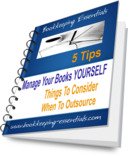
This free eBook is a copy of my article published on page 18 of the January/February 2010 issue of The MOMpreneur magazine. You can get your copy by subscribing to my free newsletter, The Bookkeeper's Notes.
In addition to 5 tips for the unincorporated small business owner, I discuss:
- when to outsource your bookkeeping work;
- the difference between a bookkeeper and an accountant;
- when it's time to hire a professional bookkeeper; and
- some things to consider when hiring a bookkeeper or accountant.
The current issue of the magazine is available at Chapters and Indigo stores.
So What in the Heck Will ...
the Bookkeeping Help be Doing?
A peek at the various services offered by bookkeepers to assist you in deciding whether you should be hiring a freelance bookkeeper or not.
- Record and properly classify your bookkeeping transactions on a regular basis to ensure you get all of your tax deductions so you pay lower taxes and keep more money in your pocket.
- Perform month-end procedures which includes credit card and bank reconciliations.
- Regular filing of your GST returns and other government compliance returns ... so you never miss a filing deadline again ... say good-bye to those late filing penalty charges.
- Prepare monthly internal financial statements to help you run your business ... and you could review the bookkeeper's work by performing the monthly financial review.
- Customize your management reporting package to your needs.
If you are behind on record keeping, months or even years, a bookkeeper can help bring your books up-to-date so that you are in compliance with the law.
If you do decide to hire a bookkeeper, you may want to consider a segregation of duties to protect your business against fraud.
Now you have an idea of what a bookkeeper does and how bookkeeping help can free you up for other tasks.
Return to Lakeshore Bookkeeping Services.
How Do Bookkeepers Charge and …
How Can I Reduce my Fee?
This article looks at how bookkeeping fees are structured. You will also find tips on how to save money on your professional fees.
This article contains a side bar on Third Party Civil Penalties.
good bookkeeping practice
THE BOOKKEEPER'S|TIP
As a business owner, you cannot fully delegate the task of your finances. Even if you hire a bookkeeper, there are tasks that you should monitor and review on an ongoing basis.
What Are Your Responsibilities ...
When You Hire a Bookkeeper?
When you hire bookkeeping help, there are some tasks that only you can do and are responsible for. Here are a few that come to mind:
- Learn what an official receipt is.
- Have a method of saving and organizing your receipts and other business records to submit to your bookkeeper on a timely basis ... especially if you want to lower your bookkeeping fees.
- Original source documents should be unaltered. You can write notes and coding on the documents. Even if you get a transaction by a bookkeeper, it does not mean you can or will "fool" a tax auditor. Your bookkeeping help will not be liable if due diligence on their part can be proven.
- Keep your personal financial affairs completely separate from your business affairs.
- Keep an auto mileage log if you want to claim business use of your personal vehicle on your annual tax return.
- Retain the appropriate paperwork to submit to your bookkeeper ... so you can claim your home office expenses ... which will reduce your tax bill.
- Keep your books and records in accordance with record retention requirements.
Your bookkeeper will probably have you sign an engagement letter explaining your responsibilities and their responsibilities.
There will probably be a clause stating that they will believe that the records you supply are true and accurate.
Canada Revenue Agency (CRA) imposes penalties on tax payers who do not observe due care in reporting their income.
Since 2000, the bookkeeper can be held responsible and is expected to provide sufficient bookkeeping service to comply with the Income Tax Act of Canada.
It is your responsibility to provide true, complete and accurate information so that your bookkeeper can act according to the law.
Neel Roberts of PTC Canada and author of "The Canadian Tax Secrets Guide" says, "Protect your integrity as a taxpayer. Make sure your information is accurate and prepared honestly."
Take a second right now to learn about the cash myth.
Then learn what it means when you sign your tax return ... because you don't want to forget that the information from your bookkeeping is used to prepare your tax return.
Always remember that getting bookkeeping help does not relieve you of your responsibilities.
Return to Lakeshore Bookkeeping Services.
The decision of how to handle your books isn’t easy. Hopefully this section of the website will assist you in your decision about “The Help” ... whether you hire yourself or outside bookkeeping help.
Bookkeeping can be fun ... if you have good bookkeeping help! :O)
Inspiration .... on making mistakes
REMEMBER ... "It's ok to try things out, to ask questions, to feel unsure, to let your mind wander, to daydream, to ask for help, to experiment, to take time out, not to know, to practise, to ask for help again - and again, to make mistakes, to check your understanding" - Jane Revell & Susan Norman
source: Karen’s Linguistics Issues “Inspirational Quotes for Teachers and Learners”

See you on the next page ...
Your tutor Lake
Home › Hire A Virtual Bookkeeper › Do I Need Bookkeeping Help?


Free eReport When You
Subscribe To My Newsletter
The Bookkeeper's Notes
Enjoy A Tea Break With
Me Today. Let's Chat!
Use the search feature to quickly find the
information you're looking for.
Join Me On Facebook
Help support this site by "liking" me! Here's where I post current information.
Listed Under Websites NOT Local Business.
This website is NOT associated with the business operating in Bonnyville AB.