- Canadian Bookkeeping Compliance Resource
- Small Business Tax Obligations
- Corporate Minute Book
Maintaining The Corporate Minute Book
By L.Kenway BComm CPB Retired
Updated March 4, 2024 | Originally Published on Bookkeeping-Essentials.com in May 2011
As an important organizational tool, a corporate minute book may not be the first thing that comes to mind when you talk about managing a business, yet it holds immense significance - particularly for small incorporated business owners in Canada. Today, we dive into the topic of "Creating and Maintaining The Corporate Minute Book In Canada".
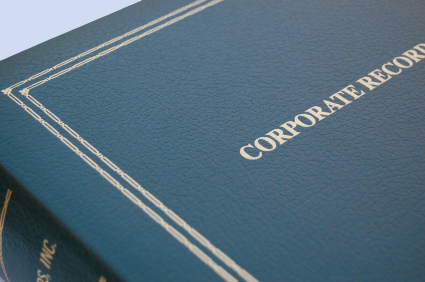 Creating and maintaining your corporate minute book in Canada
As a thriving business owner in Canada, one crucial aspect you need to acquaint yourself with is the creation and maintenance of the corporate minute book. This article is set out to provide you with insights on the importance of your corporate minute book, while ensuring you adhere to all stated legal requirements.
Please note that I am definitely NOT a legal expert in this area; I was a bookkeeper for goodness sake! I present this information so as to put the Corporate Minute Book on your radar and to facilitate a conversation with your lawyer.

What is a Corporate Minute Book?
Caution - Talk To Your Lawyer
Please use the information in this section more for talking points with your lawyer ... so you have a better feel for what kind of information you are seeking. Your lawyer will customize advice specifically for your situation ensuring your business is meeting all of its legal obligations. Think of it like this ... Having a map BEFORE you enter the forest is so much better than getting lost in the forest!
To kick things off, let's define what a corporate minute book is. It is an official corporate record holder for a company's important paperwork. It includes details about the organization's incorporation, corporate bylaws, ongoing operations, and significant corporate decisions.
Why do you need a minute book? It is the embodiment of your company's most essential decisions, serving as an historical trail. The primary reasons for a minute book include:
- legal obligation,
- providing a record of shareholders,
- providing a record of managerial decisions, and
- providing a record of key corporate decisions such as declarations of dividends payable, management fees or bonuses.
The corporate minute book:
- used to be in the form of a binder or series of binders a CCPC (Canadian Controlled Private Corporation) is required to legally maintain. However nowadays, with the advances in technology, the corporate minute binder could also be in digital format, or it can be kept in both formats;
- should be created when the corporation starts and contain documents about the creation of the company as well as records about the history of running the corporation.
- stores the significant decisions of corporate shareholders and directors, such as meetings and resolutions;
- is a practical way of organizing and keeping your important legal corporate documents intact.
You can hire your lawyer to keep this binder on their premises and maintain it on a regular basis ... for a fee of course. More on this in a bit.
One very good reason to have your lawyer maintain your minute book is it is likely to be stored in a fire proof storage area. From personal experience, it is very expensive to reconstruct a lost or destroyed minute book.
What Should a Canadian Corporate Minute Book Contain?
I recommend you have your minute book open in front of you while you read if your lawyer is not the one maintaining it for you. The Canada Business Corporation Act (CBCA) or their provincial counterparts establishes a particular set of requirements that must be included in corporate minute books.
Here is a table of the Corporation Acts for Canada:
| Province | Act | Acronym |
|---|---|---|
| Canada | Canada Business Corporations Act | CBCA |
| Newfoundland | Newfoundland and Labrador Corporations Act | NLCA |
| New Brunswick | New Brunswick Business Corporations Act |
NBBCA |
| Nova Scotia | Nova Scotia Companies Act | NSCA |
| Quebec | Quebec Business Corporations Act | QBCA |
| Ontario | Ontario Business Corporations Act | OBCA |
| Manitoba | Corporations Act of Manitoba | MCA |
| Saskatchewan | Business Corporations Act (Saskatchewan) | SBCA |
| Alberta | Alberta Business Corporations Act | ABCA |
| British Columbia | Business Corporations Act (BC) | BCA |
| Yukon | Business Corporations Act (Yukon) | YBCA |
| North West Territories | Business Corporations Act (NWT) | NWT BCA |
| Nunavut | Business Corporations Act (Nu) | BCA |
A comprehensive corporate minute book contains a trove of information. It essentially catalogues your corporation's history and decision-making process. In the binder for your corporate minute book, you should be able to see the paperwork for:
- the annual renewal of your company with your provincial and/or federal government;
- minutes pertaining to your annual general meeting;
- resolutions or decisions made by the board of directors, officers, or shareholders like dividends declared;
- various registers; and.... of course
- your incorporation papers, bylaws, and share certificates.
For Example: Alberta Corporations
For example, under Section 21(1) of the Alberta Corporations Act - Corporate Records, a corporation shall prepare and maintain at its records office records containing:
- the articles and the bylaws, all amendments to the articles and bylaws including a continuance of the corporation in another jurisdiction or revival of the corporation,
- a copy of any unanimous shareholder agreement and any amendment to a unanimous shareholder agreement,
- minutes of meetings and resolutions of shareholders,
- copies of all notices of appointments and changes of directors,
- a securities register by class or series;
- copies of the financial statements, reports; and
- a register of disclosures regarding material conflicts of interest
In addition, an Albertan corporation shall maintain:
- information on appointment and resignation of directors and officers [section 113(1)];
- changes in the registered office address of the corporation [section 20(2)(a)];
- the address of directors, officers, and shareholders [section 23(5)(c)];
- records of issuances and transfers of shares [section 49(1)];
- adequate accounting records [section 21(5)] including completed income tax returns, GST/HST returns and notice of assessments ; and
- records containing minutes of meeting and resolutions of the directors and any committee of the directors [section 21(5)].
For a list of what your minute book should contain in British Columbia, look at Section 42 (1) Records office records of the Business Corporation Act of 2002.
Let's look at some of the legal requirements in more detail.
Annual Resolutions
As mentioned, the CBCA (and their provincial counterparts) establishes a particular set of requirements that must be included in corporate minute books such as:
- Annual General Meetings (AGM)- required by law to hold at least one AGM; for a closely-held corporation, this can be done by having all shareholders sign written resolutions. Generally, the AGM must be held within six months of the fiscal yearend.
- Election of Directors - Shareholders elect directors usually for a term that ends at the next AGM where they can be reelected or step down. A shareholder resolution is required any time a new director joins the Board. Being a director comes with certain liabilities.
- Presentation of Financial Statements - Shareholders must receive annual financial statements. They are usually presented at the same time as the AGM Notice Package. The Board of Directors approve the financial statements; the shareholders only review them.
Audited Financial Statements
The CBCA (and their provincial counterparts) require audited financial statements. As this can be a very costly undertaking, the statutes make a provision for the shareholders to waive the requirement in favour of "reviewed" financial statements. This waiver must be agreed annually by all shareholders or a shareholder could require an audit to be performed.
Public filings - Annual Filings and Returns
In Canada, businesses are required to file Annual Corporate Filings with their federal, provincial or territorial government. For a Canadian Controlled Private Corporation (CCPC), the annual registration requirements include payment of the annual government filing fee and submitting an Annual Filing. These filings detail the general status of the company such as the current address, name of directors, and details of shareholders. It also affirms the continuance of operations.
If the corporation has a permanent establishment in a province other than where it is incorporated, it might also need to file extra-provincial annual filings.
You should receive an annual reminder to renew your corporate name. It can now be received by email and the Annual Filing can be completed online. In B.C., you can do this yourself using the BC Corporate Online services. [The online registry refers to it as an Annual Report.] BC makes it very easy and affordable to file your annual report online.
In 2021, I moved to Alberta and discovered that because Alberta has privatized this task, it is more difficult to file online as you cannot do it yourself like in BC. You have to go through a registered agent ... and of course it cost a lot more than filing online yourself in BC does .. so in this instance, I'm not a big fan of the privatization of this administrative task.
----- Sidebar -----
Just to clarify - I want to point out that annual filings are sometimes referred to as the "Annual Report". This does not refer to the publication released by public companies for third party use and analysis. The "Annual Report" for your corporate minute book referred to here is a the filing you are required to submit to your provincial and/or federal government.
----- End Sidebar -----
Failure to File
Failure to file your Annual Filing may result in penalties and even dissolution of your business. Federal corporations who fail to file face involuntary dissolution after two consecutive years of not filing. Dissolution means to legally end the corporation's existence. The same holds for B.C; after two consecutive years your corporation is struck from the registry. In Alberta, I believe they give you three consecutive years.
Some of the problems that may arise if your corporation is struck from the registry:
- Canada Revenue Agency (CRA) may treat the transfer of a struck corporation’s property as a deemed sale at fair market value. The corporation would owe taxes and late penalties.
- Corporations struck from the register can’t own real estate which means corporate property is transferred to government ownership.
- Corporations struck from the register and dissolved for five or more years in Alberta cannot be revived. If it has been under five years, you can go through the process of reviving the corporation and reclaiming abandoned property. If the property has been abandoned between five and ten years, your lawyer should be able to help you through the process of making a claim for the vested property. However there are some criteria that must be met to make this claim.
Honestly, it just seems easier to make the annual filings. If you are crap at paperwork, you definitely want to make your lawyer the registered office and hand over the maintenance tasks for your corporate minute book to your lawyer.
Corporation Tax Return
And of course, CCPCs must file a T2 corporate tax return each year, even if the corporation is inactive or generates no income.
----- Sidebar -----
Interesting to note that Ontario corporations' annual report was included in the filing of the corporate tax return so no annual renewal reminder was sent out. As of May 15, 2021, Ontario corporations must now file their annual returns through the Ontario Business Registry. CRA no longer accepts annual reports on behalf of the Ontario government.
----- End Sidebar -----
One final note, some changes must be reported within 15 days so you cannot wait to make the change when you submit your annual filing. A change in the registered corporate office or a change in directors comes to mind. There may more instances where this is the case.
Ledgers and Registers
Canadian corporations must maintain certain specific ledgers and registers as part of their corporate minute book. The ledgers and registers of the minute book should always be up to date. In Alberta, this includes but may not be limited to:
1. A securities register accounting for all issues of shares of the corporation by the class or series of shares.
2. A register of directors containing the names and residential addresses of each person who is or has been a director of the corporation, with the dates when they became or ceased to be directors.
3. A register of Shareholders containing names alphabetically arranged and showing the number of shares held by each shareholder.
Under the CBCA, federally incorporated corporations (other than some distributing corporations) are required to maintain a register of individuals with significant control (ISCs). However, this requirement does not apply to corporations incorporated solely under Alberta law.
Unlike in Ontario, there isn't a requirement for Alberta corporations to keep a specific real estate register. However, a register keeping track of asset ownership, including any real estate, is generally considered good practice but not legally mandated.
As you can see, legal obligations vary between federal and provincial jurisdictions. It is advisable for a corporation to seek legal advice to ensure its records are maintained properly according to relevant provincial and federal law requirements.
Do YOU Really Need a Corporate Minute Book?
Canadian law governs corporate statutes. This is where you find the obligation for a corporation to maintain a corporate minute book.
So, do you really need a corporate minute book in Canada? Yes, definitely. All corporations in Canada are legally obligated to maintain a minute book. The absence of it can stir up a host of legal and tax issues, potentially disrupting your operations.
As mentioned when discussing Public Filings above, statutory penalties may be assessed for "failure to attend to the Minute Book".
Stakeholders
A host of stakeholders are interested in your Minute book.
There are occasions when third parties may need to examine your minute book. It should be made available to them when requested. Some examples are (i) CRA during an audit, (ii) an investor wants to review the minute book, (iii) the bank if you are seeking a loan, (iv) a potential buyer, (v) making a real estate transaction, or (vi) if you transition your corporation to another province, your lawyer will need access to your Minute Book to undertake the transition.
Your Minute Book is even useful for clarifying corporate disputes and misunderstandings between shareholders.
The indispensability of Minute books in Canada cannot be overstated. Even though some businesses might consider it trivial, the law demands it, and its significance surfaces during transactions like business sales or audits.
Do You Need a Lawyer to Maintain Your Minute Book?
The automatic answer to the question of the necessity of a lawyer in maintaining your Minute Book might be 'No'. It's not strictly required, but highly recommended. This is because maintaining a corporate minute book goes beyond just clerical work; it requires a clear understanding and application of corporate law.
As a small business owner, you're at liberty to maintain your book yourself. However, given the critical nature of Minute books, the guidance of a corporate lawyer is advised.
You may need to seek legal assistance in recording some of the non-routine resolutions or decisions in your minute book. Routine documentation may or may not require legal assistance.
An example of a routine document is the resolution to accept the publication of financial statements and the appointment of the auditor. In my very limited experience, the board resolution of a CCPC could also be to waive either or both.
Another example; it is routine to have shareholder resolutions determining the number of directors, appointing the directors, naming the signatories, adopting the financial statements, other resolutions put forth including stating the annual reference date for the annual report filing.
Of course, it would be tough to know either of these two examples if you hadn't previously had your lawyer maintain your minute book. That leads me to discuss ...
What are the benefits of having a lawyer keep your corporate minute book on their premises and maintain it for you on a regular basis? Here's my thoughts:
- Compliance: Corporate minute books maintain records of significant decisions and activities by a corporation. A lawyer can ensure the material is prepared and maintained correctly in compliance with Canada's corporate law requirements, avoiding penalties and unintended legal complications.
- Expert Guidance: Lawyers are experts in corporate law. Having a lawyer maintain your minute book means you'll have someone who knows the intricacies of Canadian corporate law, ensuring complete and well-detailed minutes.
- Time-Efficiency: Maintaining a corporate minute book takes time. By delegating this task to a lawyer, business owners and corporations can focus more on the business operations, rather than administrative tasks.
- Risk Management: A wrongly maintained minute book can pose risks including inadequate documentation, improper resolutions, missed filings, etc. Lawyers can effectively manage these risks, providing a more secure situation for your corporation.
- Accessibility: Lawyers can provide appropriate and timely access to the minute books whether they are needed for inspections, audits or filings.
- Confidentiality: Lawyers must maintain total confidentiality in their dealings with clients. Letting a lawyer handle your corporation's minute book ensures that issues discussed and decisions made by your corporation's board of directors are kept confidential.
- Dispute Resolution: In times of dispute or legal conflicts, a well-maintained minute book can serve to resolve issues, providing concrete records and evidence. A lawyer with intimate knowledge of the book can aid greatly in these situations.
- Continuity: If the primary person maintaining the minute book leaves the corporation, transferring the duty to a new person may be problematic. However, if an attorney is maintaining the minute book, they provide an element of permanence and continuity, even through changes in corporate personnel.
Your Bookkeeper
Your bookkeeper should not be tasked with maintaining the corporate minute book. If your bookkeeper did play any role (and that's a big IF), it would be one of quality control. A small business owner should NOT ask their bookkeeper to:
- create the initial records for the minute book;
- "represent the contents of a minute book for the basis of legal opinion"; or
- update its content without legal representation.
If you want to take on these tasks yourself, as explained above, you do so at your own risk; but do not ask this of your bookkeeper.
The big problem of doing it yourself is of course ... you don't know what you don't know! Consider that you need resolutions for: (i) a declaration of dividends, (ii) to move your records and registered offices, (iii) a resignation of an officer or director, (iv) a share transfer, (v) issues around a death of a shareholder, (vi) declarations of new directors, (vii) replacement of lost share certificates, (viii) appointment of officers after the AGM ... I could go on.
Unless you sit and read the act, you don't know what you don't know. And even then you won't know it the way a lawyer does.
What Are The Benefits of a Minute Book?
Recognizing the benefits of a minute book is key to ensuring diligent maintenance. This includes better organization, proof of compliance, an effective way to review corporate activities, and enforcing the rights and responsibilities of stakeholders.
Other numerous benefits of a well-maintained minute book include ensuring readiness for audits, help with business sales, assistance in resolving legal questions and internal misunderstandings, and ensures regulatory compliance.
We discussed various stakeholders earlier. An example of the benefit of having an up-to-date Minute Book comes when a business owner decides to sell the business. It makes the selling process easier and less expensive.
What Are The Consequences of Not Maintaining a Corporate Minute Book?
Caution - Talk To Your Lawyer
Please use the information in this section more for talking points with your lawyer ... so you have a better feel for what kind of information you are seeking. Your lawyer will customize advice specifically for your situation ensuring your business is meeting all of its legal obligations. Think of it like this ... Having a map BEFORE you enter the forest is so much better than getting lost in the forest!
One cannot dismiss the ramifications of not maintaining a corporate minute book in Canada:
- hefty fines and potential legal penalties;
- inability to sell your corporation or delays in business transactions;
- being unprepared for audits;
- facing a potential inability to enforce your shareholder agreements;
- loss of ability to borrow funds
- loss of ability to qualify for small business capital gains deduction
- being struck from the registry
- being unable to make shareholder dividend payments
- restriction of tax stategies; or even worse
- personal liability for corporate obligations (i.e., loss of shareholders and directors' protection of personal assets)
If you are a small business owner reading this chat, I hope it has assisted you in defining what your responsibities are and when you should engage a lawyer .... or what questions you may want to ask of your own lawyer.
Other Compliance Obligations
Small Business Bookkeeping | Basic Bookkeeping
Small business bookkeeping is an age old system designed to keep financial records in an organized way. Technology has made it easier than ever to learn.
Tax Compliance for Small Business | Canadian Filing Deadlines
Tax compliance filing deadlines for small business owners - GST HST returns, payroll remittances, income tax returns and instalment payments, subcontractors


References: Canada Business Corporations Act, Alberta Business Corporations Act, DLegal Corporate minute books in Alberta, SkyLaw Spotlight On: Maintaining Your Corporate Minute Book, Barry McGuire Struck Corporations, Land Titles, and Tax in Alberta—Part 2, Kahane Law Office Annual Corporate Filings Under Alberta Law