A Financial Plan Is Essential
For The Small Home-Based Business
by L. Kenway BComm CPB Retired
Every business needs a financial plan. Without a plan, how do you know where you are going … and how will you know when you have "arrived"?
Planning is all about getting your priorities straight ... as this video shows ... WARNING do not view the video if you don't want to be uplifted, empowered or motivated to get your butt in gear.
"A goal without a plan is only a dream."
-- Brian Tracy --
"Reduce your plan to writing. The moment you complete this,
you will have definitely given concrete form to the intangible desire."
-- Napoleon Hill --
My interest is in the future because
I am going to spend the rest of my life there.
-- Charles Kettering --
You should always have a plan B ... and it sure wouldn't hurt to have a C and a D.
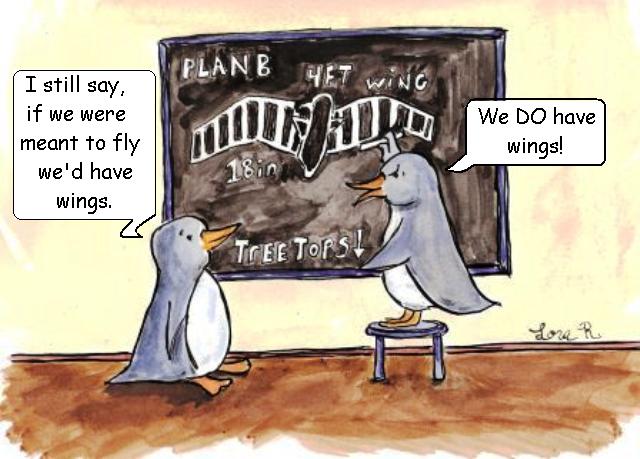
Cartoon courtesy of Advice ... with Dr. Julia Chicken who says, "Let's face it. You don't know what you're doing."
Welcome to Bookkeeping Essentials - The Road Map!
Strategic management of your business will keep you focused on your vision and goals for your business.
I am using the term financial planning here in a broad way to include your business plan and objectives, your budgeting and forecasting.
So where do you start such an overwhelming task? ...
... Start at the beginning - develop your business plan first.
Once you have your business plan in place, you will need to develop a budget ... so you have a concrete, quantitative method of tracking your progress towards ... your overall financial plan for your business.
This section is entitled “The Road Map” because it is going to discuss :
- financial planning from a strategic management point of view,
- how to create your business plan,
- how to develop your first budget (it’s not as hard as it sounds) and then
- finally how to monitor your financial plan.
There may be some side topics discussed that I think of as being more about managing the numbers side of your business ... rather than doing the actual bookkeeping (which is handled in "The Bookkeeping Practices"). If that’s the case, then you will find it under this section.
In the absence of clearly-defined goals, we become strangely loyal to
performing daily trivia until ultimately we become enslaved by it.
-- Robert Heinlein --
If it’s a skill I think you need to learn to run your business more effectively, I will post that under “The Financials Training”.
If it relates to setting up your bookkeeping system, I will post that under "The Accounting System”.
I have a series on Canadian Home Business Taxes - Tax Planning Opportunities that is located in "The Tax Articles" section.
Opportunity is missed by most people
because it is dressed in overalls ... and looks like work.
-- Thomas Alva Edison --
One point I’d like you to keep in mind as you work your way through this section ... I will try to tie any topic covered in this section back to good bookkeeping practices and how your bookkeeping system can help you run and manage your business. This site is all about bookkeeping after all! ;-)
Luck is not chance ... it's toil.
Fortune's expensive smile is earned.
-- Emily Dickinson --
Purpose of Financial Planning
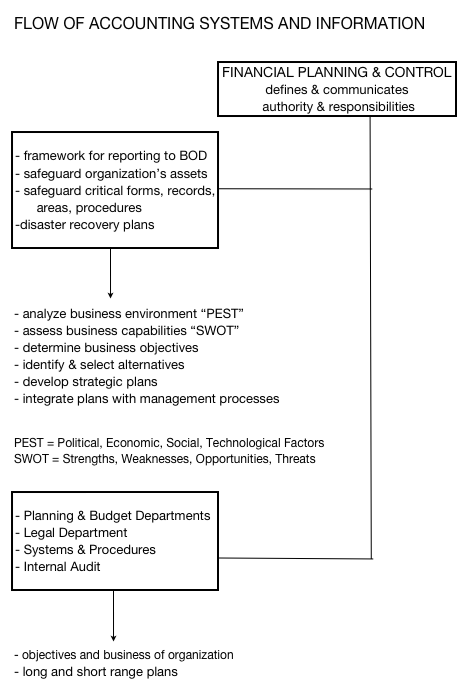
Sometimes a picture can say more than words. I've put together a flowchart that depicts the purpose and objective of having a financial plan for your business. As your business grows, you will want to refer to this flowchart to make sure you haven't missed anything while developing and conceptualizing your plans.
The flowchart shows how your accounting systems and accounting information flows and pertains to financial planning.
In a small unincorporated business, your Board of Directors (BOD) will likely be your trusted advisors / mentors. Your "departments" will likely be outsourced to various professionals.
The big thing to notice is you are trying to define and communicate authority and responsibilities.
Take time before you start on your financial plan to read Steve Pavlina's article 10 Stupid Mistakes Made By the Newly Self-Employed at:
www.stevepavlina.com/blog/2006/04/10-stupid-mistakes-made-by-the-newly-self-employed
Following are executive summaries of the chats I've together that provide instructions on the practical side of making and monitoring your business plans.
Just click on any link of your choice and you'll go right to the page.
Bookkeeping Facilitates ...
Informed Business Decisions
Capture your progress of the goals you have identified and set. Let your accounting system help YOU make informed business decisions.
Originally, I had planned to have you join me while I took you through the process I used to create a business plan for my small home based business.
But there is just so much information out there on how to do it ... and sites that have tools to help you build your financial plan ... so instead of following my original plan, I'm going to refer you to a great site ... or two.
Keith Anderson CPA-CA's website has a very good guide on Why Prepare a Business Plan. The article includes links on how to develop your own business plan. It is an easy read where he shares his expertise on the subject.
You read a book from beginning to end. You run a business the opposite way.
You start with the end, and then you do everything you must to reach it.
-- Harold Geneen --
Canada Business.ca has a free interactive business planner that you might consider using to get started. This site is hosted by the Government of Canada. I talk more about it here along with other government sites sponsored by the Australian and UK governments.
So for now all I'll share about my financial plans is my dream to have multiple sources of active and passive income (not putting all my eggs in one basket ... so to speak) ... this site being part of the dream. You see, I don't have a company pension plan. The long term goal is financial independence ... even without the luxury of a company pension plan.
Four Secrets to Customizing Your Bookkeeping Reports ... to Meet Your Needs
Plan ahead to customize your financial reporting package to meet your specific information needs.
Financial reporting is an essential planning tool that helps YOU mine your valuable small business information records.
Your accounting reports can help you make better business decisions ... if you spend some time planning your information needs properly.
You'll find four secrets to help you on your way.
Creating Your First Budget
Budgeting is one component of financial planning. It is easy to create a budget if you are systematic, logical, and thoughtful. For example, tie your budget into your business plan by putting numbers to your plans for the coming year.
To create your budget, follow these general guidelines.
- Work on one account / category at a time from your income statement.
- Keep notes on your assumptions. It will help when you have to try to figure out why you are out from your budget.
- Budget at the level of detail you want to track and monitor. It may be different for each account / category.
- Make sure you account for one time items as well as the ongoing items.
- There is usually a lot of consistency from year to year, so look at last year's actual results to help you build this year's budget.
Once I've drawn up a budget, I like to review it and classify all the items as a way to set my priorities ... because I want and like to meet my financial planning goals. I reorganize expenses into discretionary (need to have) and non-discretionary (want or nice to have).
If you use QuickBooks and have at least one year's worth of data, QuickBooks can create a budget for you based on last year's actual results. You can then edit the information to reflect your goals for the coming year ... and adjust it for one time versus ongoing expenditures.
Budgeting gets easier the longer you do it ... so your first budget may take some time as you begin to quantify your vision into actual financial results, but each year you will get better at it and it won't take as long to develop.
Forecasting, How is it Different from Budgeting?
Budgeting is creating amounts for each category of revenue and expense ... and then tracking your progress at meeting your budgeted amounts.
It is your short term plan on what you expect your financial results to be. On a regular basis, you review the differences to determine why you over or under spent within each category.
Forecasting is projecting into the future ... like running a "what if" scenario.
While my budget for the year remains static once I have finalized it , my forecasting is always changing.
I like to use the forecast so I can see the effect of changes I know are going to happen that are different from what I anticipated when I drew up my budget.
The more you budget, the easier it becomes each year to create a new budget ... especially if you have been forecasting on a regular basis.

It's been great chatting with you .
Your tutor Lake


Free eReport When You
Subscribe To My Newsletter
The Bookkeeper's Notes
Enjoy A Tea Break With
Me Today. Let's Chat!
Use the search feature to quickly find the
information you're looking for.
Join Me On Facebook
Help support this site by "liking" me! Here's where I post current information.
Listed Under Websites NOT Local Business.
This website is NOT associated with the business operating in Bonnyville AB.